Easily recognizing a copy of Napoleon III furniture
Recognizing a copy of Napoleon III furniture
Napoleon III furniture has been widely copied, with varying degrees of success, over the years.
Difficult to copy because they are rich in marquetry and in bronzes, it is easy to understand that for contemporary copyists, who seek to limit manufacturing costs, it is on these two points that the differences will show.
One can distinguish the “old” copies, such as the so-called “faubourg” productions of the years between 1920 and 1960, which are generally copies of good quality, since the bronzes are rather well chased and the woods look old. They are harder to detect; one must look at the construction of the drawers, the veneers used, the absence of traces of old tools, and the engraving of the marquetry.
As for the bulk of the copy market, one finds pieces that are easy to identify as such. The copies come mainly from Egypt, from Asian countries, from a few Eastern European countries and from Italy.
Here are the important points that should enable you to avoid making a mistake.
1/ The bronzes
Period Napoleon III bronzes are heavy and thick, the chasing is fine and they show a great deal of relief. The faces are well drawn, delicate, quite refined.
On the copies, the bronzes are flat, without relief, the chasing is coarse, the faces are unrefined, even ugly, and the gilding is dull, almost white. They are often alloys rather than pure bronzes.
Copyists cannot afford to fit quality bronzes on their copies, as these are very expensive, so they mount low-quality pseudo-bronzes on the piece.
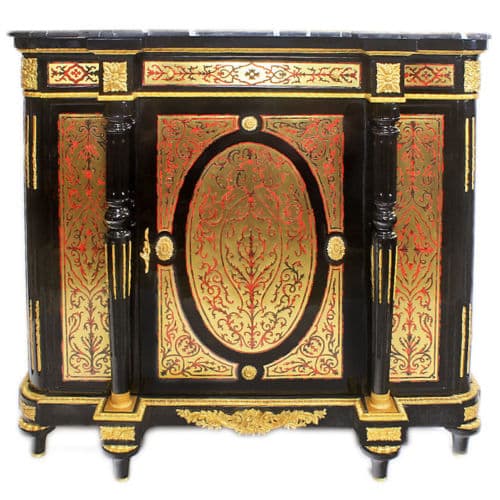
A classic of copied furniture… bronzes without relief, no brass stringing, no engraving of the metal parts, uniform imitation tortoiseshell…
2/ The brass stringing
Almost always, Napoleon III furniture is inlaid with brass stringing. Copies rarely have any, because this marquetry technique is long and costly, and copyists cannot allow themselves the expense. Beware: some go so far as to create fictitious stringing, generally painted with gold paint, which can give the illusion of real stringing. You will then need to look closely…
A concrete example with the piece below, a contemporary copy, devoid of brass stringing.
3/ Drawers on side cabinets
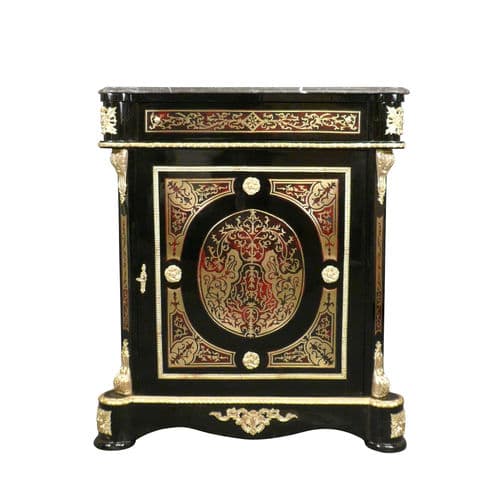
For practical reasons, copies of side cabinets are almost always fitted with a drawer in the upper section. Yet practically no period Napoleon III side cabinet had a drawer. Another example with this piece, which has one, adorned with two modern knobs that are not very convincing…
4/ The engraving of the brass elements.
On Napoleon III furniture, the great majority of the brass elements are engraved internally. This gives additional relief to the marquetry. On copies, the brass pieces are free of any engraving, once again to avoid the significant cost that engraving represents. Some skilful Italian copies deliberately “dirty” the brass marquetry to make one think it is old…
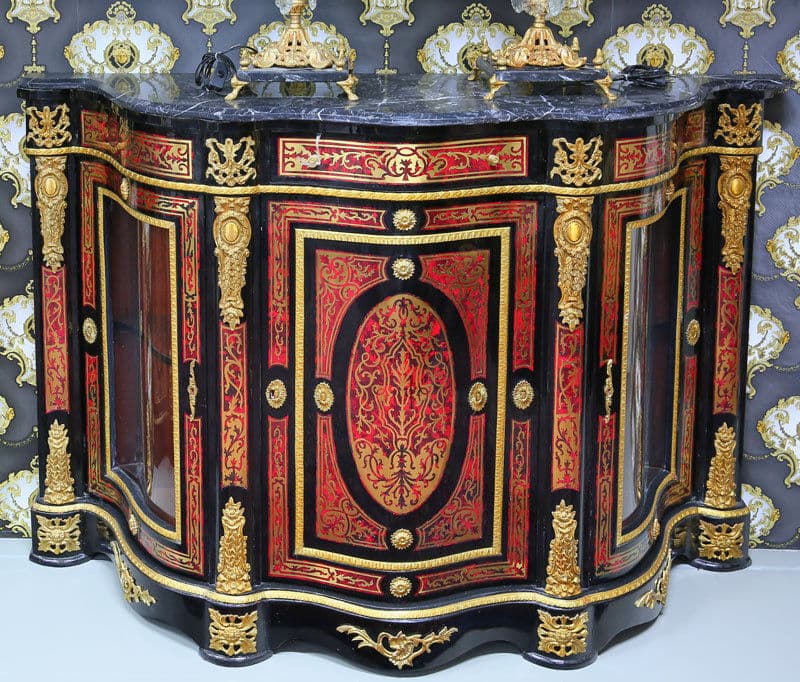
You will note, on the piece above, that not a single brass element is engraved…
5/ Tortoiseshell
On copies, you will obviously never find tortoiseshell, for reasons of cost, of course. You will find paint imitating tortoiseshell, resin, or any similar material.
Look closely: you will see either repetitive, symmetrical spots, or a kind of motif recurring in several places, no craquelure, no imperfection — an impression of “too perfect” that you will never find on old tortoiseshell, even restored.
And plenty of other small details (look at the back of the piece — the wood is often recent and of mediocre quality; look underneath, likewise), a recent marble top (easy to see from below), etc.…
To sum up:
Buying a copy is a choice. Be aware that, over time, a copy will sometimes deteriorate very quickly (I have seen copies losing their veneers after 3 or 4 years), that the visual effect is very far from that of a genuine period piece, and that the piece’s value at resale is close to nil — all the more vexing since some copies are very expensive. I have seen, on certain commercial websites, copies of side cabinets selling for more than 1,000 euros, whereas at that price, or by adding a few hundred euros, one can find period pieces — admittedly unrestored, but in decent condition — which will not lose a cent with age, quite the contrary.
In any event, buying a period piece is always preferable, unless a copy is offered at a very, very much lower price and your budget does not allow the acquisition of an authentic piece.
Do not hesitate to send us photos if you have any doubts; we will gladly enlighten you, to spare you a costly mistake…
Continue reading
Market prices
Observed price ranges, family by family, to buy at the right price.
Read the articleCabinetmakers under Napoleon III
Befort, Diehl, Sormani… the great names of Second Empire cabinetmaking.
Read the articleBoulle marquetry explained
Understanding the technique of Boulle marquetry, tortoiseshell and brass.
Read the article