The materials used in marquetry
Inlay and marquetry materials
Tortoiseshell
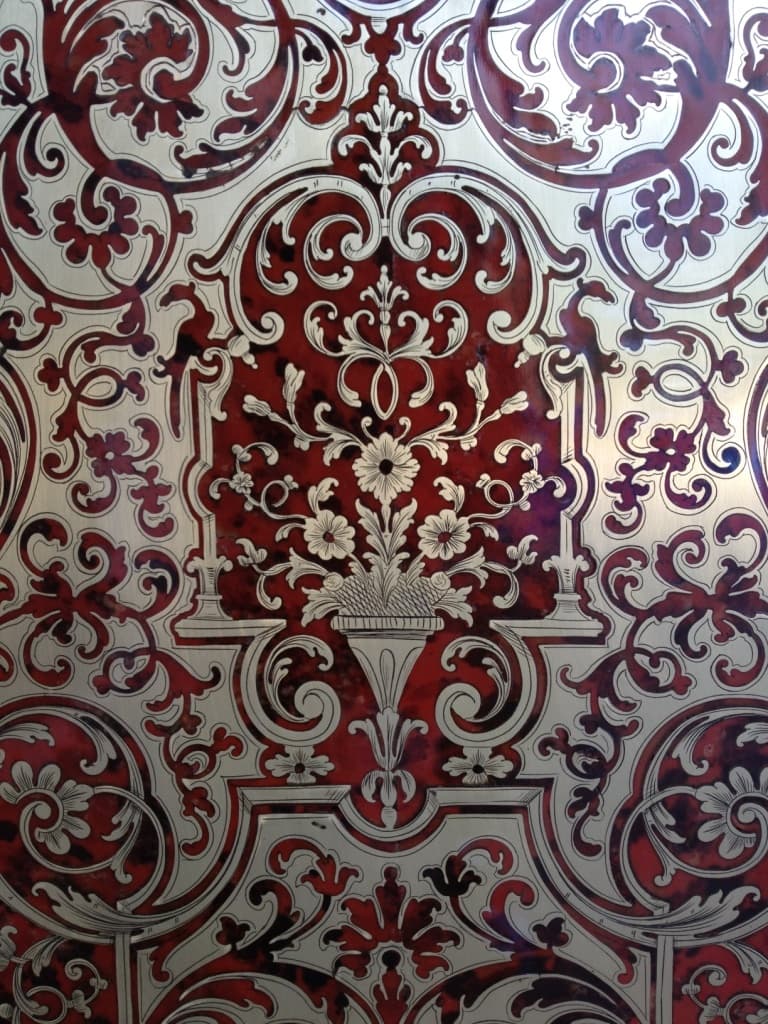
The finest and rarest tortoiseshell comes from the turtle Eretmochelys imbricata, commonly known as the hawksbill, which lives in warm waters. It is a noble material, fascinating for its many reflections ranging from honey to dark brown and for its transparency, and it has been used since Antiquity. Its reputation is also due to its transparency and to the many ways in which it can be worked. In France, its greatest use is found in the furniture of Louis XIV, particularly in the pieces of the cabinetmaker André-Charles Boulle. “Boulle” furniture, which takes up the designs of Bérain, is veneered with metal and with tortoiseshell tinted either with glues or by laying it over a painted ground, playing on the transparency of the shell.
Brass
Known since Antiquity, brass is an alloy of copper and zinc in variable proportions. It is called “yellow copper”, which shows how easily it can be confused with copper. It often forms the galleries surrounding gueridon tops, but is also applied in thin sheets in Boulle marquetry.
Pewter
Extracted from tin-bearing mines in various regions of the world, pewter was regarded as a precious metal by the earliest civilizations. It was used to make utilitarian objects as well as applied ornament on furniture in place of silver, notably in the Boulle marquetry of the 17th century.
Straw
Straw, generally rye straw, is dyed and plaited before being used in the making of seats. There is another use for straw: straw marquetry. This is a French tradition dating back to the 18th century. The technique resembles wood marquetry: gluing onto paper, cutting out the ground and setting the motif back in place. In the 18th century, production consisted mainly of cases, caskets and small pieces of furniture. In the 1940s and 1950s, André Groult revived this tradition, creating highly refined furniture with this humble wisp of straw.
Ivory
This is a white, hard, close-grained substance that forms the main material of the teeth and tusks of animals such as the walrus, the rhinoceros or the elephant. But the term “ivory” applies only to elephant tusks. Ivory has always been a precious material. Ivory is worked like wood and, like wood, shrinks as it dries. Its tones are uneven and can vary over time and according to origin: ivory can yellow, take on a russet-brown patina or even whiten. The art of ivory was already flourishing in the France of the 11th century. It appears in the marquetry of 17th-century cabinets as thin engraved plaques inlaid into ebony. Because of its animal origin, the exploitation of ivory constitutes a genuine threat to the species that produce it. Its use in the decorative arts is not prohibited, but today it is subject to regulation.
Mammoth ivory
It is one of the substitutes for elephant ivory. It is fossil ivory. It comes from Siberia; its availability is low and its price high, but its trade is not yet regulated.
Vegetable ivory, tagua or corozo
It comes from the albumen of the fruit of the ivory palm Phytelephas (literally “plant elephants”), which grows in the Amazonian forests. Before ripening, the fruit contains a sweet milk (albumen). As it hardens, it becomes vegetable ivory — the seed, known as tagua or corozo. One tree produces roughly 20 kg of seeds per year, roughly the weight of the tusks of a 6-tonne elephant. It was the Spanish who first discovered vegetable ivory at the end of the 18th century. Trade with Europe grew up around the manufacture of buttons and small objects, and enjoyed great success until the arrival of plastic at the beginning of the 20th century set it into decline. Today, vegetable ivory is making a comeback thanks to a few committed associations and the impetus of leading designers. Its advantages are many: a natural product, unique shapes — no two seeds are alike — and an aesthetic alternative to ivory. The only problem: the size of the seeds. The seeds that reach Europe are at most the size of an egg, which limits their use.
Other ivory substitutes
There are other substitutes for elephant-tusk ivory: the horny casque of the cockatoo, bone, resins… Among the latter: micarta. It is an assembly, under pressure and heat, of phenolic resins and compacted paper or fabric. Micarta can be found in various colours, notably ivory tones. This resin imitates the feel of ivory and, in part, its appearance, apart from the cracks and imperfections. It has the advantage of great resistance to rot and corrosion.
Ivorine is another substitute. It is a reconstitution of ivory made from ivory powder and resin. Like micarta, its appearance is free of cracks and without structure.
Bone
Bone, generally from cattle or sheep, is strong and light and lends itself to every kind of shaping: it can be sawn, turned, polished and dyed. Left natural and polished, it gives a creamy white and can substitute for ivory.
Mother-of-pearl
It is a calcareous substance with iridescent reflections, secreted by the mollusc of the shell throughout its life. Unlike the shell itself, mother-of-pearl regenerates when it has been damaged in the living shellfish. It is sought after for the making of buttons and jewellery, for small precious objects, but also for the marquetry of caskets and furniture. Mother-of-pearl is softened in boiling water before being flattened and cut. It can be tinted with organic dyes. The first mother-of-pearl came from the pearl oyster, later replaced by the trochus shell of New Caledonia.
Horn
Horn is composed of keratin and is found on cattle, goats and sheep. It is a fragile material. It is also sensitive to drying out and must be fed with oil or grease to prevent cracking or shrinkage. A traditional material in knife-making, it was also used by marquetry-makers and makers of small precious objects; some Boulle marquetry is executed in horn.
Antler
Antlers (from stags or roe deer) are a bony growth that grows and is shed each year. It is a strong material whose colour varies from brown to light beige depending on the species. Sometimes textured, sometimes very smooth, antlers are used mainly in knife-making, but they are also found as ornament in cabinets of curiosities.
Plastics
Plastics are polymers whose basic raw materials may be: – vegetable, such as cellulose derived from wood or cotton; celluloid belongs to this category of plastic — an artificial plastic material invented in 1869 by the Americans Wesley and Hyatt. Based on camphor, cellulose and alcohol, celluloid has many qualities: lightness, strength, richness of colour. But it is flammable. It can imitate ivory and tortoiseshell. – animal, such as milk casein, which combined with formaldehyde gives galalith, or “milk stone”, – mineral, such as bakelite, composed of a resin derived from coke converted into gas.
Among the qualities of plastics one may cite lightness, transparency and impermeability. Most of them appeared at the end of the 19th century, when the chemical industry developed. Celluloid, ivorine, cellulose acetate, bakelite, galalith, micarta, ebonite — it is not always easy to distinguish them from the natural materials they imitate: ivory, tortoiseshell…
Marble and other hard stones
In furniture, marble served above all to cover the tops of pieces (commodes, tables or consoles) in the form of:
– a single slab, or as a facing on Renaissance sideboards. Fashion changed the colours: under Louis XIV coloured marbles were favoured, such as Rouge Royal (which is a Campan marble); the Louis XVI style would lean towards sober white or grey marbles… – or a marquetry of hard stones. It was the Italians who applied to furniture the technique of intarsia, or marquetry of polychrome stones, in the 16th century. The Medici founded in Florence a manufactory devoted to hard-stone mosaics. Tops with motifs of geometry, landscapes, bouquets or animals were covered with marble, chalcedony, onyx, jasper, lapis lazuli, agate, petrified wood, etc. This expertise was exported throughout Europe — to the court of Rudolf II, to the Gobelins manufactory under Louis XIV, to Madrid — spreading with it the style of Florentine hard-stone marquetry.
Three types of gems are recognized: precious stones (diamond, emerald, ruby, sapphire, alexandrite), fine stones (formerly called semi-precious, grouping together the transparent gems not classed among the precious stones, such as garnet, topaz and rock crystal) and finally the hard or ornamental stones, such as agate, amber, chalcedony, jade, jasper and lapis lazuli, but also coral and pearl.
An example of hard stone: rock crystal
Rock crystal is a quartz, most often colourless and transparent. It is extracted from deposits in the Alps or in Brazil. In the Middle Ages it is found as a decorative element of reliquaries, alongside other semi-precious stones. It was also used to make columns in the architecture of Renaissance cabinets.
Coral, often classed among the hard stones
Coral is a microscopic animal that branches out throughout its life, forming, with its countless fellow creatures, the coral reef. Its colour ranges from white to pink, dark red and even black. It lives in the warm seas of China and Indonesia as well as in the colder waters of the Mediterranean or off Great Britain. Since Antiquity it has been used in jewellery, in small precious objects and in marquetry, and it adorns the most sumptuous cabinets.
Continue reading
Market prices
Observed price ranges, family by family, to buy at the right price.
Read the articleCabinetmakers under Napoleon III
Befort, Diehl, Sormani… the great names of Second Empire cabinetmaking.
Read the articleBoulle marquetry explained
Understanding the technique of Boulle marquetry, tortoiseshell and brass.
Read the article